

The 'Sandwich' Board Crisis: Why 2026 Mobile Gaming is Causing Motherboard Desoldering and How Micro-Soldering Saves Your Data
Introduction: The Hidden Cost of High-Frame-Rate Gaming
If you’ve noticed your flagship smartphone getting uncomfortably hot during a session of Genshin Impact or the latest 2026 competitive shooters, you aren't just feeling "performance." You’re feeling the literal degradation of your device's internal architecture. Over the last year, we’ve seen a massive spike in devices entering our lab with "no power" or "stuck on logo" issues, and the culprit is almost always the same: thermal expansion leading to mobile gaming motherboard desoldering.
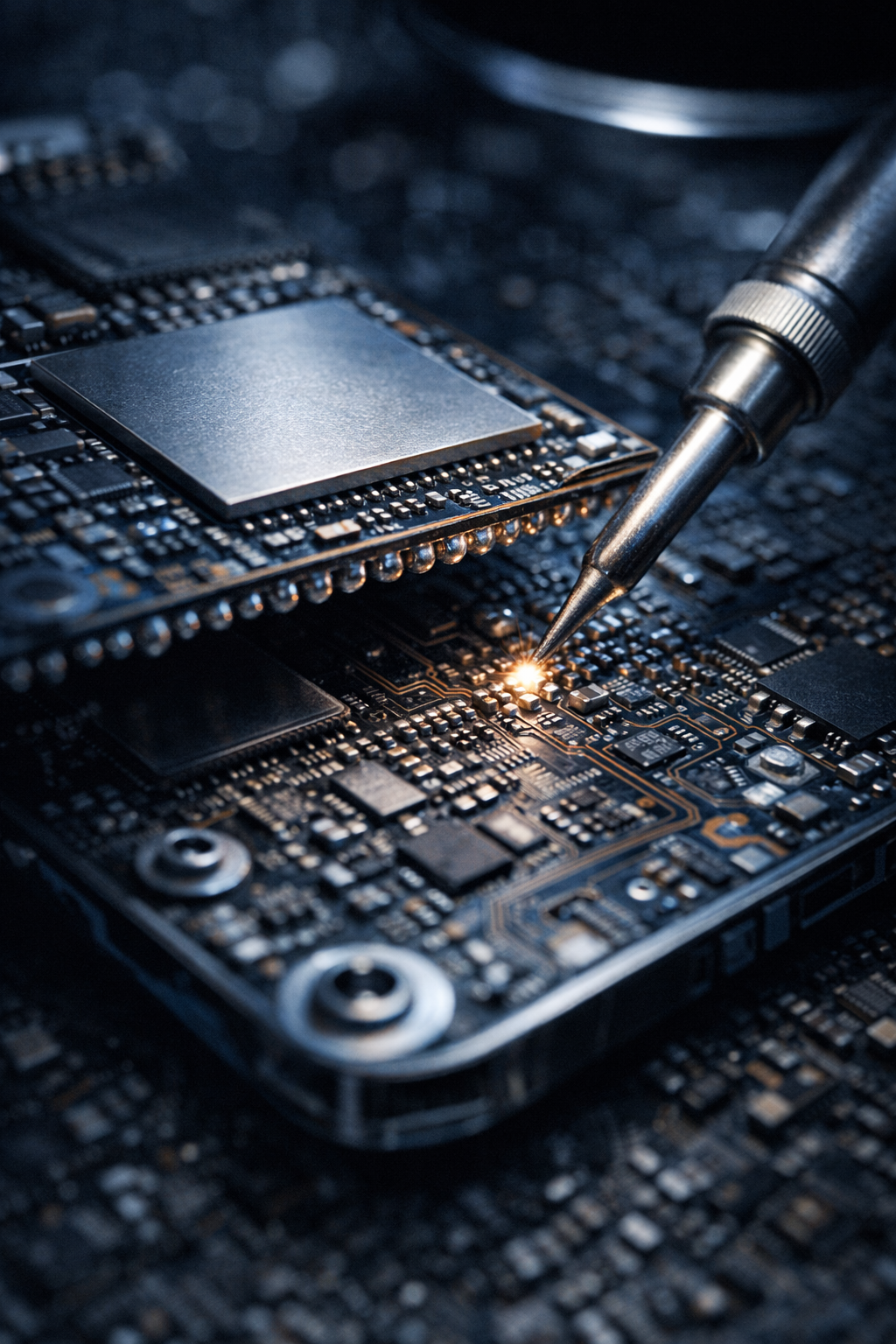
Modern phones use a "sandwich" board design—two circuit boards stacked on top of each other. While this saves space, it creates a heat trap. As a technician who has spent thousands of hours under a microscope, I can tell you that the heat generated by sustained gaming is now officially outpacing the cooling capabilities of modern hardware. When that heat has nowhere to go, the solder joints holding your CPU and RAM together begin to crack.
Section 1: The 'Sandwich' Board Anatomy and Thermal Failure
To understand why your phone suddenly died, you have to look at how it’s built. Manufacturers utilize "Interposers"—small solder rims that connect the top logic board to the bottom one. This creates a dense, multi-layered "sandwich."
In 2026, mobile games are pushing GPUs to their absolute limits, often reaching internal temperatures that rival budget laptops. Because these devices lack active fans, the repeated heating and cooling cycles cause the metal solder to expand and contract. Eventually, a microscopic fracture forms. This is the "Sandwich Board Crisis." Once a single data line under the CPU or between the boards breaks, your phone becomes a high-tech paperweight. This isn't just a software glitch; it is a structural mechanical failure that requires
Section 2: Identifying the Symptoms of Board Separation
You don't usually wake up to a dead phone without warning. There are several "tells" that your motherboard is beginning to fail due to mobile gaming motherboard desoldering:
Intermittent Wi-Fi or Bluetooth: Often, the chips controlling connectivity are located near the edges of the sandwich board. If they start dropping signals, the board may be warping.
Touch Disease or Screen Flickering: Even if your screen isn't cracked, a failing board connection can mimic a broken digitizer.
The "Random Reboot" Loop: This is the most common sign that the CPU's connection to the motherboard is compromised.
We’ve observed these patterns across multiple brands. When the internal structure reaches a critical temperature, the solder becomes "mushy," and any slight drop or even the pressure of your grip can shift the components. Understanding
Section 3: Why Micro-Soldering is the Only Real Cure
When a manufacturer's "Genius" or "Pro" tech tells you that you need a full motherboard replacement, they are usually trying to avoid the complexity of the real fix. A full board replacement means you lose all your photos, messages, and encrypted data.
Micro-soldering is the surgical art of re-establishing those microscopic connections. Our
Advice for Gamers:
Use an External Cooler: If you game for more than 30 minutes, a clip-on peltier cooler is no longer optional.
Avoid Fast-Charging While Gaming: This creates a "double-heat" effect—one from the battery and one from the processor.
Back Up Constantly: If you see the symptoms mentioned above, back up your data immediately and
contact us
Section 4: Conclusion and Final Thoughts
The 2026 mobile landscape is a race between software power and hardware limits. While phones are becoming more capable, they are also becoming more fragile under the stress of high-end gaming. The 'Sandwich' Board Crisis is a reminder that "thin and light" often comes at the cost of thermal longevity.
If your device has fallen victim to mobile gaming motherboard desoldering, don't panic and assume your data is lost. While the failure is serious, micro-soldering provides a path to recovery that a simple parts-swap cannot. We take pride in our
FAQs
Can I fix a desoldered motherboard at home?
Absolutely not. Micro-soldering requires a high-end digital microscope, infrared pre-heaters, and precision soldering stations. Attempting to "bake" your board (a common internet myth) will likely melt plastic connectors and destroy the device permanently.
Will a motherboard repair delete my data?
No. Unlike a motherboard replacement offered by the manufacturer, micro-soldering repairs your original board, keeping your data chips intact and your files right where you left them.
How long does a micro-soldering repair take?
Due to the complexity of splitting and re-joining sandwich boards, these repairs typically take 3–5 business days to ensure proper testing and thermal stability.
Disclaimer: This information is for educational purposes regarding hardware failure. Internal smartphone repairs involve high heat and delicate components. We strongly recommend seeking a professional technician to handle motherboard-level issues to avoid permanent data loss or battery fires.