

The UWB Chip Crisis of 2026: Why Your Phone's Ultra-Wideband Tracking Is Quietly Killing Battery Life and Triggering Logic Board Failures
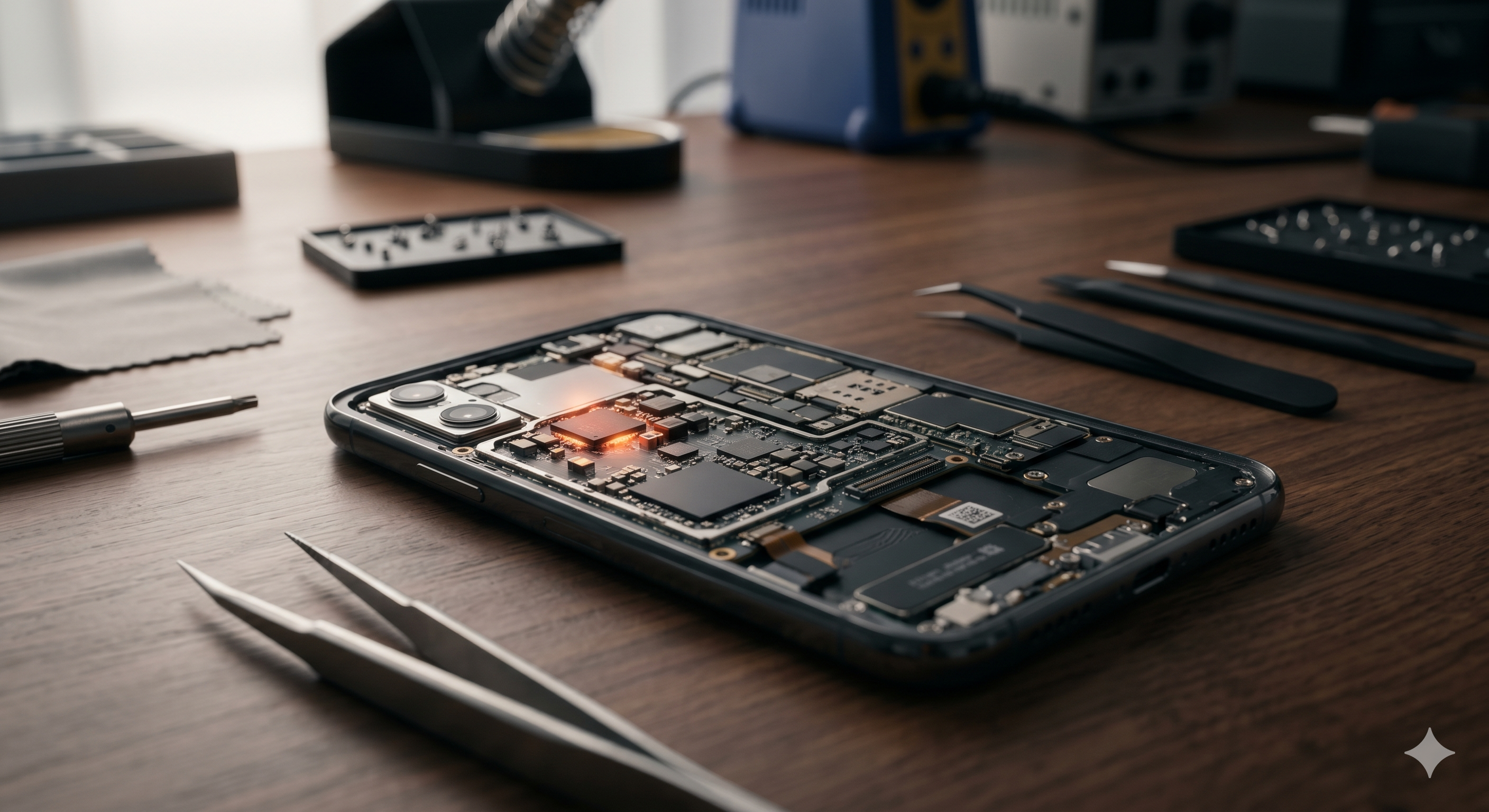
If your iPhone 15 Pro or Galaxy S24 Ultra is suddenly running hot, draining battery overnight, or losing AirTag and SmartTag connections at random, you may be looking at one of the fastest-growing hidden problems in modern smartphones. UWB chip failure has gone from a rare edge case in 2024 to a steady stream of repairs across our Clive and Ankeny benches in 2026. Most owners have no idea it is even happening because the symptoms look like normal aging.
Ultra-Wideband technology powers everything from precision item finding to digital car keys to seamless Apple TV handoff. When the chip behind these features starts to fail, it does not throw an error. It just keeps trying, again and again, burning power and stressing nearby components on the logic board. We have spent the last few months tracking exactly what is going wrong, and the pattern is now clear enough to share.
Section 1: What Ultra-Wideband Actually Does Inside Your Phone
Ultra-Wideband is a short-range radio technology that uses extremely wide frequency bands to measure distance and direction with centimeter-level accuracy. Apple uses Apple's U1 and U2 chips. Samsung uses NXP's UWB modules. Google has joined in with the Pixel 8 Pro and newer. According to the FCC's official documentation on UWB technology, these chips operate between 3.1 and 10.6 GHz, which is a much wider range than Wi-Fi or Bluetooth.
The chip is constantly active in the background. It scans for nearby AirTags, SmartTags, paired car keys, HomePods, and other UWB devices. Even when you are not actively using a finder feature, the chip is listening, transmitting brief pings, and reporting back to the main processor. On a healthy phone, this happens at very low power. On a degrading chip, the same task can pull five to ten times the normal current.
This is similar to the kind of constant background load we covered in our breakdown of the AI Performance Cliff and Neural Engine strain on older flagships. Different chip, same underlying pattern of silent power drain.
Section 2: Why UWB Chips Are Failing in 2026
Three things are happening at once. First, the UWB chips themselves were designed for moderate use. Apple introduced the U1 in 2019, and the workload has multiplied since then. Find My, Precision Finding, digital car keys, AirDrop directional handoff, and HomePod handoff have all stacked onto a chip that was never tested for this much daily activity.
Second, thermal stress from gaming and on-device AI is cooking nearby components. We documented the desoldering pattern on flagship logic boards in detail before, and the UWB chip sits in one of the hottest zones on the board. Repeated heat cycles cause micro-fractures in the solder joints connecting the chip to the board. Once that connection degrades, the chip starts pulling more power to maintain signal strength.
Third, software updates in 2026 are aggressively waking the UWB chip. Recent iOS and Android releases use Ultra-Wideband for new features like spatial audio handoff and proximity-based smart home triggers. A chip that was already on the edge gets pushed past it.
The result is a phone that feels fine on the surface but is silently bleeding battery and stressing the power management circuit feeding the chip. Left unchecked, the load can take out the PMIC or the surrounding voltage rails.
Section 3: The Warning Signs Most People Miss
UWB chip failure does not announce itself. There is no error message, no warning popup, nothing in the settings menu that says the chip is dying. Instead, the symptoms look like a tired old phone. That is exactly why people ignore them until something bigger breaks.
The first sign is unexplained battery drain. Your phone is at 80 percent at lunch and 30 percent by dinner with normal use. Battery health still shows 90 percent or higher. Standard battery diagnostics turn up nothing unusual.
The second sign is sustained warmth in the upper third of the phone, near the top edge where the UWB antenna sits. The phone is not hot enough to throttle, but it is noticeably warm when you pick it up after it has been sitting on the table.
The third sign is intermittent failures with UWB-dependent features. Precision Finding stops working with your AirTags. Your digital car key occasionally fails to authenticate. AirDrop sometimes refuses to find devices that are right next to you. Each individual failure is easy to dismiss. Together, they paint a clear picture.
The fourth sign is the most serious. Some failing UWB chips eventually short the rail that feeds them, which can pull down the whole board. We have seen phones come in with a complete no-power condition that traced back to a degraded UWB module.
Section 4: Conclusion and Final Thoughts
UWB chip failure is one of those problems that only becomes obvious when you know what to look for. The technology is genuinely useful, and most phones will go their whole lifespan without an issue. But for the unlucky percentage where the chip gives out, the cost of ignoring the warning signs can climb fast. A simple chip replacement on a healthy logic board is one thing. A board-level repair after a power rail short is another conversation entirely.
If your phone is showing battery drain you cannot explain, gets warm at the top edge for no clear reason, or has started losing UWB-dependent features, do not assume it is just an old battery. Get the device looked at. A proper diagnostic takes about twenty minutes and tells you exactly what is happening inside. From there, the right fix becomes obvious.
For anyone in the Des Moines metro, both our Clive and Ankeny locations handle UWB-related diagnostics regularly. Our iPhone repair team and Samsung repair specialists are familiar with this specific failure mode and can tell you straight whether your phone needs a chip-level repair, a full board swap, or just a battery. You can also grab an instant quote before bringing the device in. Catching UWB chip failure early is genuinely the difference between a small fix and a big one.
FAQs
Q: Can I just disable UWB to stop the problem?
On iPhone you can turn off Precision Finding and disable some U1-related features under Privacy and Location Services. On Samsung you can disable Nearby Device Scanning. This reduces the load but does not stop the chip from being powered. If the chip is already damaged, disabling features only delays further degradation, it does not reverse it.
Q: Is UWB chip failure covered under warranty?
Usually only within the first 12 months and only if there is no sign of physical damage or liquid exposure. Most failures show up in year two or three, after the warranty has expired. Always check your specific terms before assuming you are covered.
Q: How much does a UWB chip repair typically cost in 2026?
It varies based on the model and the extent of the damage. A clean chip replacement on an undamaged board is one of the more affordable board-level repairs. If the failure has spread to the PMIC or other rails, the cost goes up significantly. We always quote upfront after a diagnostic.
Q: Will a new battery fix UWB-related drain?
No. A new battery masks the symptom for a few weeks but the chip continues pulling abnormal current. The drain comes back, often worse than before. The actual fix is at the chip level.
Q: Are newer phones less likely to have this problem?
The 2025 and 2026 flagships use updated UWB modules with better thermal design. Early data suggests they are more reliable, but the technology is still relatively new. We will know more after another year of real-world use.
Disclaimer
This article is for informational purposes only and reflects observations from our Clive and Ankeny, Iowa repair shops. Individual device behavior may vary depending on usage, environment, and manufacturer revisions. For specific concerns about your device, we always recommend consulting either the original manufacturer or a trusted local repair professional.